
Why Language Goals Fail
Why do most English goals fail? This article explains why most students quit even before see progress in English and how to set goals your brain can follow.
ENGLISH
1/24/20263 min read


Just like every year, you probably started with a goal like this:
“This year, I’ll finally improve my English.”
“I need to pass the exam this year.”
“I won’t quit this time.”
For a while, you try.
You study.
You show up.
But after a few weeks, something changes.
English starts to feel tiring.
Progress feels slow.
And suddenly, stopping feels easier than continuing.
So you blame time.
Or motivation.
Or life.
But most of the time, that’s not the real reason.
Very often, the brain quits early.
Before we go on, think about your own New Year’s resolutions.
One that worked.
One that didn’t.
Keep those in mind, because the same brain rules apply to language learning.
Below are three research-based reasons language goals fail, and how to fix them.
1. Most Language Goals Have No Clear Finish Line
Researchers at NYU studied what happens when people start difficult tasks.
They found something surprising.
When people could see a clear end point before starting:
Their brain registered the task as easier
Their body prepared for effort more efficiently
Their performance improved—even when the task was objectively hard
The work didn’t change.
Only the perception of effort did.
The same thing happens in language learning.
When adults see a clear plan—broken into small, concrete actions—they are far more likely to continue. The brain likes roadmaps. It relaxes when it knows what’s next.
Now look at most language goals:
“Improve my English”
“Practice vocabulary”
“Get better at speaking”
That feels more like fog not a finish line.
And when the brain can’t see the next concrete step, effort feels heavier than it really is. That’s what overwhelms learners—not laziness, not lack of motivation, but mental uncertainty.
2. Positive Visualization Isn’t Enough
We love positive thinking.
But research shows something important:
The brain sticks to habits better when it also understands what happens if we don’t act.
If I don’t practice speaking, fluency doesn’t magically appear.
If I avoid mistakes, progress stops.
If I keep waiting to “feel ready,” nothing changes.
Effective goal design isn’t about dreaming of fluency someday.
It’s about clearly seeing the cost of not practicing.
That doesn’t mean being negative.
It means doing what good learning design already does best:
giving learners a clear plan
removing ambiguity
making consequences visible
When learners understand both directions—progress and stagnation—the brain chooses action more often.
3. Outcome Goals Are the Weakest Goals
The weakest goals focus only on outcomes:
“Reach B2”
“Sound fluent”
“Get a high score”
“Speak perfectly”
Research shows these goals don’t improve performance very well. Even very specific outcome goals often perform no better than “just do your best.”
Why?
Because outcome goals don’t tell the brain what to do today.
The Strongest Goals Are Process Goals
Process goals focus on actions, not results.
For language learners, that means:
how you practice
how often you speak
how skills are repeated over time
A process goal asks:
“Did I show up and practice the skill?”
Not:
“Was it perfect?”
Learners with process goals:
improve more
speak better under pressure
build confidence over time
The Skill That Keeps You Going
It's not motivation. Motivation always fades. That’s normal.
What matters next is self-regulation.
Can you:
notice what isn’t working?
adjust instead of quitting?
treat mistakes as information, not failure?
This skill determines whether English feels energizing or exhausting.
Research also shows something critical:
Goals only improve outcomes when feedback is present.
Feedback doesn’t mean grades or dashboards.
It means noticing:
what’s getting easier
what’s still hard
what feels sustainable
what feels forced
Without feedback, even good goals lose power.
The Real Formula for Progress
Before setting a goal, get clear on three things:
Direction + Traction + Adaptation = Change That Lasts
Direction
Why are you learning English right now?
Not someday. Not “in general.”
Now.
Traction
What can you practice consistently without friction?
Short. Doable. Repeatable.
Adaptation
What signals will tell you to adjust instead of quit?
Faster word recall?
Smoother speaking?
Fewer pauses?
When goals:
mean something to you,
are supported by feedback,
and are built to adjust,
time and motivation stop being the problem.
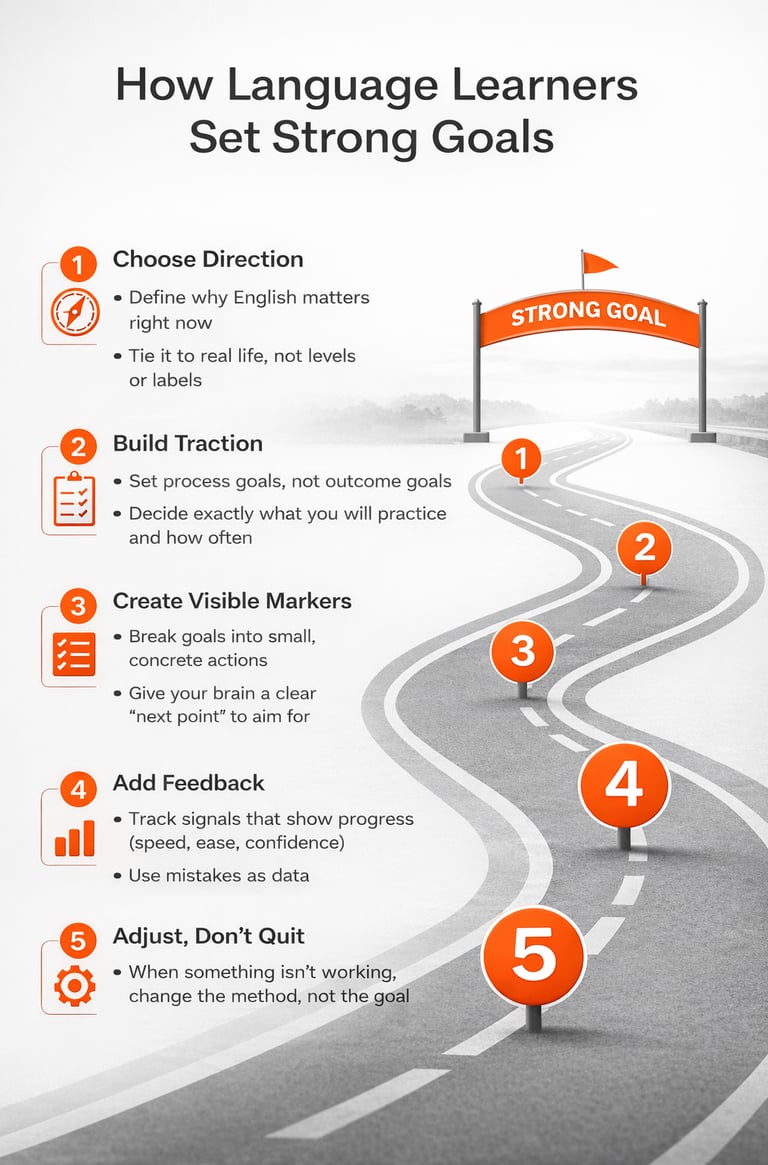
TLDR; How to Build Strong Language Goals
Step 1: Choose Direction
Tie English to real life—not levels or labels.
Step 2: Build Traction
Set process goals. Decide exactly what you’ll practice and how often.
Step 3: Create Visible Markers
Break goals into small, concrete actions your brain can see.
Step 4: Add Feedback
Track progress signals. Use mistakes as data.
Step 5: Adjust, Don’t Quit
Change the method—not the goal.
That’s how you stop language goals from failing. And that's how you start making progress instead of starting from scratch every year.
Free Mini Video Course
I'll send you 5 short videos with secrets about how to trick your brain into remembering and using what you learn
contact
eu@englishuniversity.pro
© 2025. All rights reserved.