
Why “Think in English” Is Terrible Advice
Why ‘think in English’ is bad advice for fluency. Learn what neuroscience says actually helps adults speak English naturally and confidently.
ENGLISH
11/23/20254 min read


I still remember the first time (back in 2003) someone told me:
“If you want to be fluent, you need to start thinking in English.”
It sounded smart, advanced.
And it sounded like the missing key.
So I tried.
I forced myself to monitor my thoughts.
I corrected myself mid-sentence.
I tried to catch Russian before it appeared and replace it with English.
What happened?
I didn’t become fluent.
I became slower, more tense, and painfully self-aware.
But it's not like I was failing at English.
I was following a lot of bad advice, and it was one of them.
Years later (after teaching adults, working with professionals, and diving deep into how the brain actually processes language), I realized something uncomfortable:
Everyone had been repeating this advice because it sounds right, not because it works.
If you’re reading this, chances are you’ve heard it too.
And chances are you’ve felt the same frustration.
Let’s talk about why.
The Moment I Realized “Think in English” Doesn’t Work
What Research Actually Says About “Thinking in English”
The core problem with this advice is simple:
You can’t consciously choose the language you think in.
Neuroscience is clear on this.
Thought does not begin as language.
It begins as sensation, emotion, intention, and imagery.
Words come later—as labels.
Telling someone to “think in English” is like telling them to:
control their heartbeat
digest faster
stop seeing red so they can see blue better
You can influence these systems indirectly—but you can’t command them.
Cognitive Load Makes It Worse
Adult learners already rely heavily on the brain’s control center (the prefrontal cortex) to:
monitor grammar
search for vocabulary
self-correct
judge accuracy
Now add one more task:
“Also, make sure your thoughts are in English.”
The result isn’t fluency but overload.
Research on cognitive load shows that when the brain is overburdened:
speech slows down
pauses increase
anxiety rises
working memory collapses
That’s why learners freeze mid-sentence.
Not because they don’t know English.
But because they’re thinking too much.
Fluency Lives in a Different Memory System
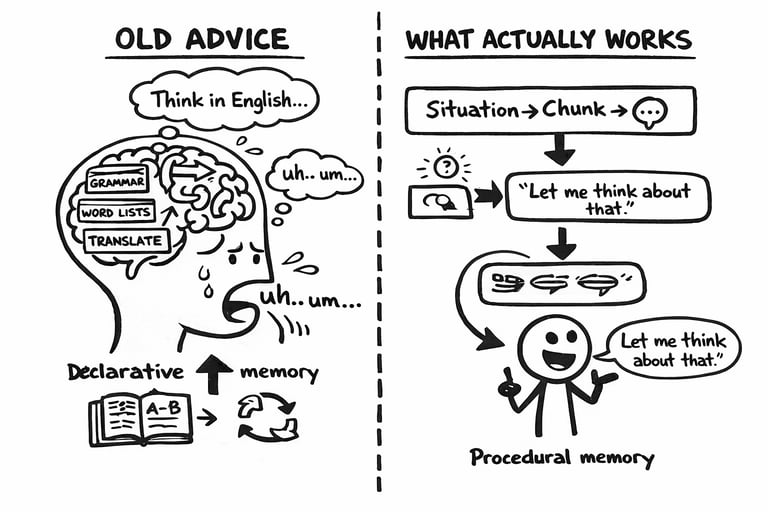
Fluent speech does not come from declarative memory (rules and facts).
It comes from procedural memory. It's the same system responsible for:
driving
typing
playing sports
musical performance
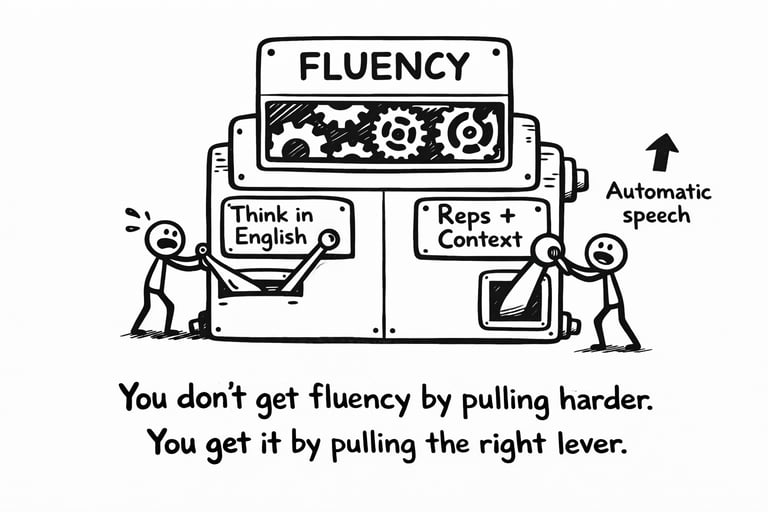
You don’t think your way into procedural memory.
You train it through patterns, repetition, and context.
“Think in English” traps learners in the wrong system.
What Students Should Do Instead (That Actually Works)
If “thinking in English” doesn’t lead to fluency, what does?
Here’s what works in the real world.
1. Respond Before You Feel Ready
Fluency grows through use, not preparation.
Instead of waiting for the perfect sentence:
respond quickly
accept imperfection
keep the flow moving
Speed beats accuracy in the early stages of fluency activation.
2. Learn in Chunks, Not Sentences
Fluent speakers don’t build sentences word by word.
They retrieve chunks.
Examples:
“Let me think about that.”
“What I mean is…”
“From my perspective…”
Chunks bypass grammar analysis and go straight to output.
This is how natural speech actually works.
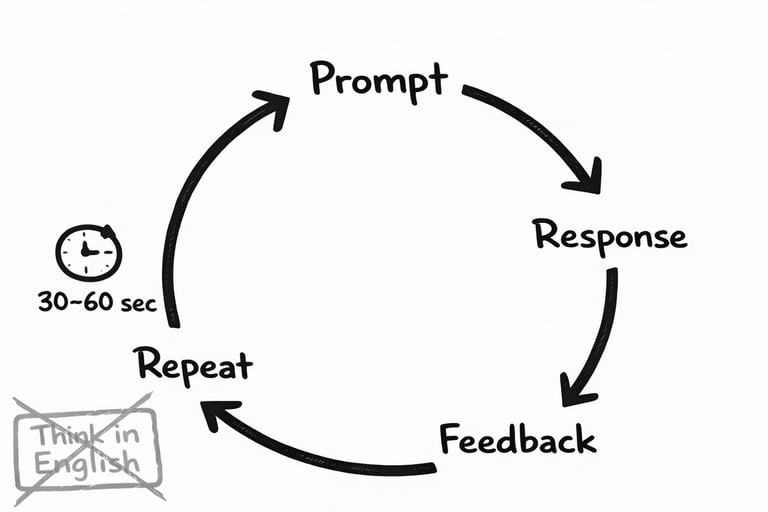
3. Train Short Speaking Reps
Fluency is built with micro-reps, not long speeches.
What helps:
30–60 second answers
familiar prompts with slight variation
frequent repetition under low pressure
This mirrors how the brain automates any skill.
4. Focus on Meaning First, Polish Later
A clear, imperfect sentence is neurologically stronger than a perfect sentence that never comes out.
Confidence creates momentum.
Momentum creates fluency.
Classroom Techniques and Tactics for Teachers
If you’re a teacher, this is where everything changes.
1. Stop Asking for “Correct Answers”
Ask for responses.
Design tasks where:
meaning matters more than form
students must react, decide, or respond
grammar is refined after communication
Fluency grows in action, not explanation.
2. Use Constraint-Based Speaking
Constraints reduce overthinking.
Examples:
one sentence only
20 seconds max
no notes
must start with a given phrase
Constraints free the brain by narrowing options.
3. Repeat Prompts, Not Just Content
Repetition is not boring to the brain—it’s stabilizing.
Use:
the same prompt across multiple days
small variations in context
predictable structures
This is how procedural memory forms.
4. Normalize Translation Without Shaming
Students will translate.
That’s normal.
The goal is not to eliminate translation—it’s to outgrow it naturally through faster access.
Shame slows learning.
Safety accelerates it.
5. The Reframe That Changes Everything
Replace this advice:
❌ “Think in English.”
With this:
✅ “Respond in English, even if it’s imperfect.”
✅ “Use what you already have.”
✅ “Train reactions, not rules.”
Or remember this one line:
Fluency is a reaction, not a set of rules.
Final Summary
Most adult learners are stuck in English because they’ve been taught to overthink instead of activate.
When we stop fighting the brain and start training it the way it actually learns, fluency stops being mysterious.
It becomes inevitable.
Free Mini Video Course
I'll send you 5 short videos with secrets about how to trick your brain into remembering and using what you learn
contact
eu@englishuniversity.pro
© 2025. All rights reserved.