
How to Get Through the End-of-Year Motivation Dip
Why December makes you want to quit and how to stay in the process without forcing yourself. This article is based on neuroscience research and principles of adult learning. It includes practical strategies for both students and teachers.
ENGLISH
12/29/20254 min read


At the end of one class, I once asked a student:
"What feels harder right now: English itself, or showing up to class?"
She paused and said:
"It’s not that English is difficult. I’m just tired. I’ve lost motivation."
Her level hadn’t dropped.
Her English hadn’t “regressed.”
What disappeared was a sense of why she needs to learn English.
Not “I can’t do this anymore,”
but “I don’t understand why this matters right now.”
And when that why fades, motivation doesn’t collapse loudly.
It leaks out quietly, almost unnoticed.
What Research Says About Motivation and Goals
Andrew Huberman often talks about motivation not as being in the mood for something, but as a byproduct of what we attach our actions to.
Research shows the same pattern again and again:
People abandon goals faster when those goals exist on their own.
They persist longer when goals are embedded in identity.
These people don’t say,
“I should improve my English.”
They say things like,
“I’m an ambitious person, and it matters to me to feel on equal footing with Americans.”
That’s why they continue even when it gets hard.
English becomes part of who they are, how they live, and who they are becoming.
When people study English because “it might be useful someday,”
English is the first thing they give up on during stressful periods or when they have too many competing priorities.
But when English is:
“Part of me, my life, and my success in the world,”
it survives December, fatigue, and overload.
So the problem isn’t the end of the year.
And it’s not the holidays.
The problem is a too-narrow “why.”
Long-term goal-adherence studies show the same thing:
People quit faster when the goal is only about themselves (“I want to be better”).
People persist longer when the goal is tied to roles, values, and contribution.
In other words, motivation weakens when the goal is only about you.
It strengthens when the goal is connected to:
the kind of person you’re becoming
the people who depend on you
the impact you want to have
Tips for Students
1. Change the reason, not the plan
Instead of asking:
“How do I stay motivated?”
Ask a different question:
“Who will it matter to if I don’t give up right now?”
“Whose life improves if I keep going and improve my English?”
Possible answers:
“I’m learning English to feel more confident at work.”
“I’m learning English to find a different job.”
“I want my kids to see what it means not to quit and to invest in yourself.”
“I’m becoming someone who finishes what they start.”
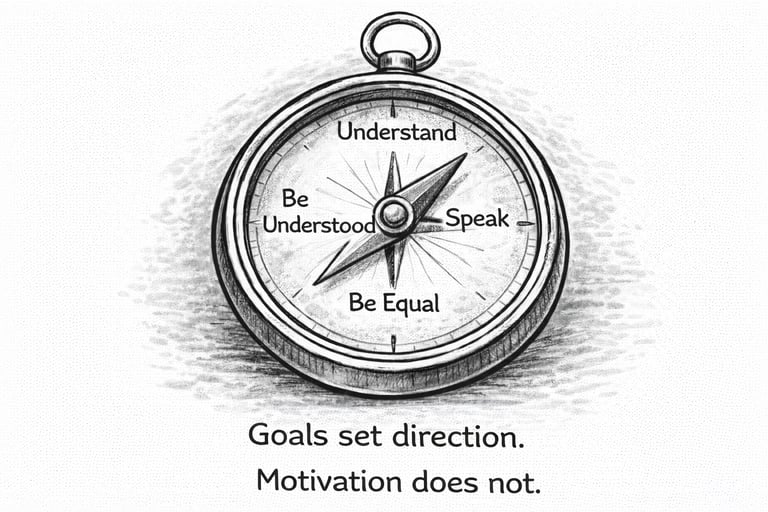
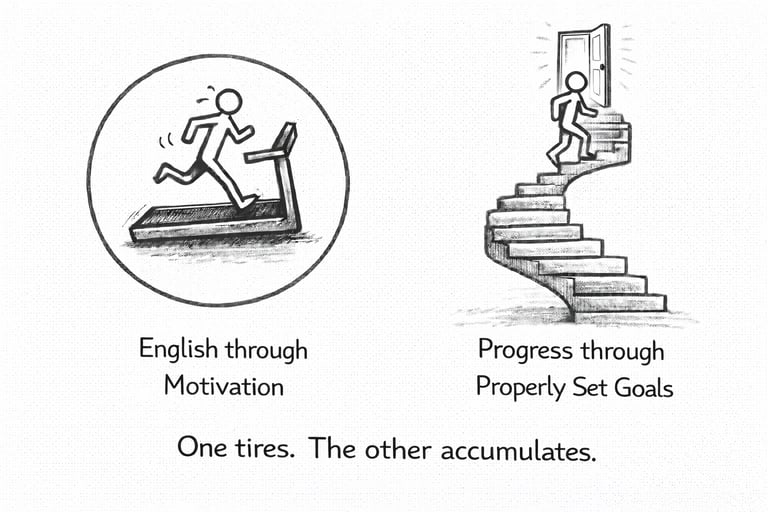
Motivation doesn’t survive on urgency or pressure.
It survives on well-defined goals with meaning.
2. Tie English to identity
This is about internal standards. Compare the two:
a) “I’m learning English.”
b) “English is part of my life and how I show up in the world.”
People rarely say this out loud, but this is how it feels internally.
When English becomes part of identity instead of a separate goal, everything changes.
You continue not because you should,
but because stopping feels wrong.
This is how habits survive real life:
not through constant effort, but because they are part of who you are.
You don’t need heroic discipline or long study sessions.
You don’t need a perfect routine.
You need small, regular signals to your brain:
“I’m still here. I haven’t quit English.”
Those signals keep the connection alive, even when it’s inconvenient, exhausting, or not the priority of the day.
3. Don’t aim for perfection in December
Many adults “drop out” not because they don’t want to learn, but because they believe:
“If I missed a few classes or can't be consistent, I might as well just restart later.”
That belief destroys motivation.
December is not the time for a push.
It’s the time to stay in the process.
Strategies for Teachers
(Based on principles of adult learning)
Adult learners don’t “lose motivation.”
Their English goals are competing with other priorities in life and are taking a backseat.
Here’s what helps maintain that connection.
1. Emphasize
the Why, not volume
A core principle of adult learning: people need to understand why something matters.
In December:
reduce new content
connect tasks to real-life use
explain how current practice supports future progress
When meaning returns, motivation follows.
2. Offer choice and autonomy
Another adult-learning principle: motivation increases when learners feel control.
When life feels overwhelming, autonomy becomes essential.
Even small choices help:
topic selection
response format (spoken, written, audio, discussion, group project, etc.)
depth (brief response vs. deeper exploration)
Choice reduces resistance and sustains engagement.
3. Normalize the dip without encouraging stopping
Emotions are part of learning.
Say this out loud:
“Right now, energy is low for many students. We’re not aiming for big progress. We’re aiming to stay in the process.”
This removes shame, one of the biggest motivation killers.
A Reframe That Changes Everything
Motivation doesn’t disappear at the end of the year.
It loses its anchor.
To bring it back, you don’t need a new plan or a reset.
You need a stronger reason.
Try finishing this sentence:
“I’m working on my English because ______ needs me to become the kind of person who can _______ (make more money, call school, talk to the child's friends, doctor, teacher, etc).”
Sometimes that’s enough to keep December from becoming an exit point.
In Conclusion
You don’t need to push yourself in December.
You don’t need to wait for a January reset.
You need to remember why you started.
When learning outcomes are tied to identity rather than mood,
motivation stops being something you have to chase
and becomes something you can quietly return to.
Free Mini Video Course
I'll send you 5 short videos with secrets about how to trick your brain into remembering and using what you learn
contact
eu@englishuniversity.pro
© 2025. All rights reserved.